US Postal Service announces changes to postmark policy

The U.S. Postal Service is changing the postmark process. For decades, the postmark was used to show when mail was accepted by the post office, but now the postmark will reflect the date an envelope is first processed by an automated sorting machine and not the drop-off date. This article advises customers to mail time sensitive mail pieces several days before a given deadline. Or go to a retail location and receive a postmark date that aligns with the date on which the postal service first accepted possession of their mail piece.

Click here for the full article published in the Federal Register. The official journal of the federal government of the United States that contains government agency rules, proposed rules, and public notices.

Click here to go to MSN NBC News, Today Show report on postmark policy change.

Posted in: Blog

Leave a Comment (0) →
Winterizing Your Mountain Home

Cartoon image of outside water spigot. Reminding you that every winter season, homeowners in our mountain community are at risk of the damage and expenses caused by frozen pipes. Disconnect and drain outside hoses. Insulate pipes and faucets. Seal off access doors, cracks, and around vents. Lastly locate your customer shut-off Valve. www.pcwd.org 951-659-2675

Posted in: Blog

Leave a Comment (0) →

Mountain Disaster Preparedness

Natural disasters & extreme weather are increasingly severe. In an emergency help may not arrive on the Hill for days. 70% of survivors of disasters are rescued by other survivors. When disaster strikes, your neighbors are your first responders. Are we ready?

Neighbors Helping Neighbors
How to have a neighborhood meeting & improve mutual safety and resiliency during crisis.

Where: Idyllwild Town Hall, 25925 Cedar Street
When: 6:30 – 8:00 PM Thursday, October 16
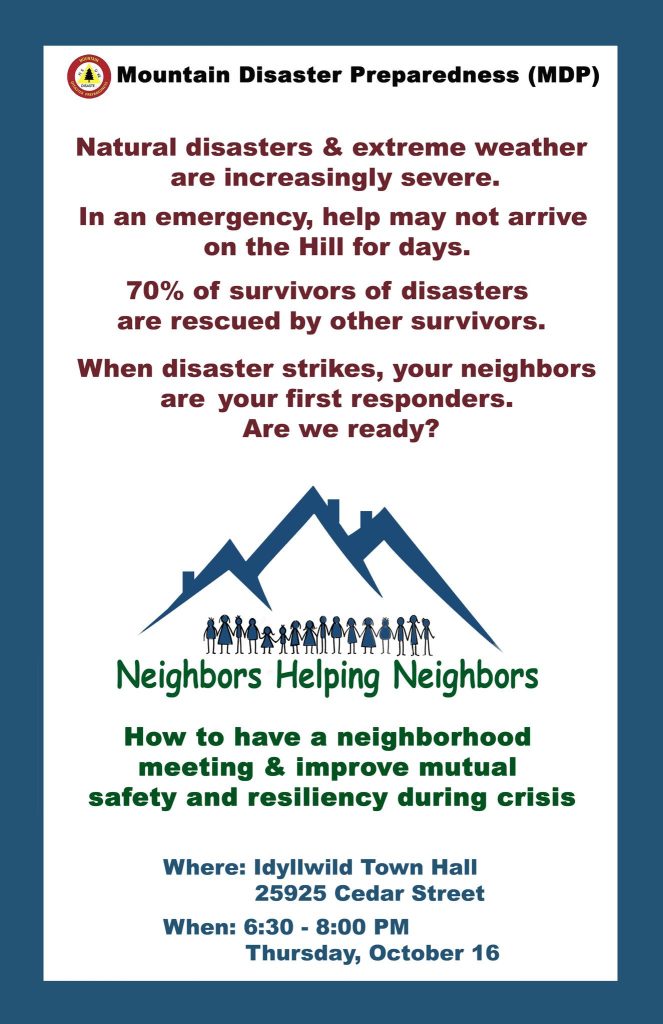
Mountain Disaster Preparedness How to have a neighborhood meeting & improve mutual safety and resiliency during crisis Idyllwild Town Hall Thursday October 16 6:30-8pm

Posted in: Blog

Leave a Comment (0) →

25 Things YOU Can Do To Prevent Water Waste

9 Things you can do to save water in the bathroom

  1. Check your toilets for leaks. Put a little food coloring in your toilet tank. If, without flushing, the color begins to appear in the bowl, you have a leak that should be repaired immediately
  2. Stop using the toilet as an ashtray or wastebasket. Every time you flush a cigarette butt, facial tissue, or other small bit of trash, you waste five to seven gallons of water
  3. Put plastic bottles in your toilet tank. To cut down on water waste, put an inch or two of sand or pebbles inside each of two plastic bottles to weigh them down. Fill them with water and put them in your toilet tank, safely away from operating mechanisms. In an average home, the bottles may displace and save ten or more gallons of water a day.
  4. Take shorter showers. Long, hot showers can waste five to ten gallons every unneeded minute. Limit your showers to the time it takes to soap up, wash down, and rinse off.
  5. Install water-saving shower heads or flow restrictors. Your local hardware or plumbing supply store stocks inexpensive water-saving shower heads or restrictors that are easy to install.
  6. Take baths. A bath in a partially filled tub uses less water than all but the shortest showers.
  7. Turn off the water after you wet your toothbrush. There is no need to keep water pouring down the drain. Just wet your brush and fill a glass for mouth rinsing.
  8. Rinse your razor in the sink. Fill the bottom of the sink with a few inches of warm water. This will rinse your blade just as well as running water, and is far less wasteful.
  9. Check faucets and pipes for leaks. Even the smallest drip from a worn washer can waste 20 or more gallons a day. Larger leaks can waste hundreds.

6 Things you can do to save water in the kitchen and laundry

  1. Use your automatic dishwasher only for full loads.
  2. Use your automatic washing machine only for full loads.
  3. If you wash dishes by hand, don’t leave the water running for rinsing. If you have two sinks, fill one with soapy water and one with rinse water. If you have only one sink, gather washed dishes in a dish rack and rinse them with a spray device or a panful of hot water.
  4. Don’t let the faucet run while you clean vegetables. Just rinse them in a stoppered sink or a pan of clean water.
  5. Keep a bottle of drinking water in the refrigerator. Running tap water to cool it off for drinking water is wasteful.
  6. Check faucets and pipes for leaks. Leaks waste water 24 hours a day, seven days a week, and often can be repaired with only an inexpensive washer.

10 Things you can do to save water outside

  1. Water your lawn only when it needs it. A good way to see if your lawn needs watering is to step on the grass. If it springs back up when you move, it doesn’t need water. If it stays flat, fetch the sprinkler.
  2. Deep-soak your lawn. When you do water, do it long enough for the moisture to soak down to the roots where it will do the most good. A light sprinkling can evaporate quickly and tends to encourage shallow root systems.
  3. Water during the cool parts of the day. Early morning generally is better than dusk since it helps prevent growth of fungus.
  4. Don’t water the gutter. Position your sprinklers so water lands on the lawn or garden, not on paves areas. Also avoid watering on windy days.
  5. Plant drought-resistant trees and plants. Many beautiful trees and plants thrive with far less watering than other species.
  6. Put a layer of mulch around trees and plants. Mulch will slow evaporation of moisture and discourage weed growth, too.
  7. Use a broom, not a hose, to clean driveways and sidewalks.
  8. Don’t’ run the hose while washing your car. Clean the car with a pail of soapy water. Use the hose just to rinse it off.
  9. Tell your children not to play with the hose and sprinklers.
  10. Check for leaks in pipes, hoses, faucets, and couplings. Leaks outside the house may not seem as bad since they’re not as visible. But they can be just as wasteful as leaks inside. Check frequently and keep them drip-free.

Posted in: Blog

Leave a Comment (0) →

It’s Time to Get Serious about Saving Water

  • The Bathroom :
    1. Our toilet doesn’t leak
    – Put a few drops of food coloring in your toilet tank. If the coloring begins to appear in the bowl
    without flushing you have a wasteful leak that should be repaired at once.
    2. We don’t use our toilet as a wastebasket
    – Flushing a used facial tissue down the toilet wastes about 2 gallons of water.
    3. We have a toilet that uses only 1.6 gallons of water or less.
    – All toilets sold after 1992 are required to use no more than 1.6 gallons per flush. New
    high-efficiency toilets operate very well with even less water. If you have an older toilet, you may
    save from 2 to 4 gallons per flush by replacing it with a new model. You may also be eligible for
    an incentive to lower the cost of that new toilet – check www.bewaterwise.com for more
    information.

    4. We take quick showers.
    – Limit your showers to the time it takes to soap up, wash down, and rinse off – 3 to 5 minutes.
    Also, when waiting for the water to warm up, catch the cold water in a bucket; use it to flush the
    toilet or help water the yard.
    5. The adults in our family turn off the water while shaving.
    – Fill the sink with a few inches of water in which to rinse your razor.
    6. Our bathroom faucets and pipes do not leak.
    7. We have installed water-saving shower heads or flow restrictors.
    – Run your shower into a bucket for 30 seconds. If more than 1 1/2 gallons (6 quarts) of water are
    in the bucket, you need a flow restrictor. Your hardware or plumbing supply store stocks
    inexpensive, easy to install shower heads and flow restrictors that still give you cleansing,
    refreshing showers.

    8. We take baths with shallow water.
    – A partially filled tub uses less water than all but the shortest showers.
    9. We turn off the water while brushing our teeth.
    – Before brushing, wet your brush and fill a glass of water for rinsing your mouth.

  • Kitchen and Laundry
    10. We use the automatic dishwasher only for full loads.
    – It uses less water than washing by hand.
    11. We use the automatic washing machine only for full loads of laundry.
    12. We don’t let the faucet run to clean vegetables.
    13. We keep a container of drinking water in the refrigerator.
    – Running tap water to cool it for drinking wastes water.
    14. When we wash dishes by hand, we don’t leave the water running for rinsing.
    – If you have two sinks, fill one with rinse water. If you have only one sink, put your washed dishes
    in a dish rack and rinse them quickly with a spray device or pan of water.
    15. Our kitchen and laundry room faucets and pipes do not leak.

  • Outside
    16. We water the lawn only when it needs it.
    – Step on your grass. If it springs back when you life your foot, it doesn’t need water. Check
    bewaterwise.com for tips on watering and plants. If you have an irrigation system, upgrade to a
    Smart Controller that automatically adjusts the amount of water for weather conditions.
    17. We water during the cool part of the day.
    – Early morning is better than dusk, since it helps prevent the growth of fungus.
    18. We deep soak our lawn.
    – When you water your lawn, water it long enough for the water to seep down to the roots where
    it is needed. A light sprinkling, which sits on the surface, will evaporate and be wasted.
    19. We don’t water the gutter.
    – Position your sprinklers so the water lands on your lawn or garden, not on concrete or other
    paved areas. Also, avoid watering on windy days.
    20. We’ve made our landscape California Friendly with trees and plants naturally suited to our
    climate.

    – Many beautiful trees and plants thrive with little water in our semiarid region.
    21. We put a layer of mulch around trees and plants.
    – Mulch slows the evaporation of moisture.
    22. We use a broom instead of a hose to clean driveways and sidewalks.
    23. We don’t let the hose run while washing the car.
    – Soap down your car from a pail of soapy water. Use a hose only to rinse it off.
    24. The children do not play with the hose and sprinklers.
    25. We have no leaks in pipes, hoses, faucets, and couplings.
    – Leaks outside the house can be extremely wasteful. To check for hidden leaks in your pipes,
    make sure no water is being used around the house and watch the water meter for 10-15
    minutes. If the meter shows some movement during that time, you have a leak.

Posted in: Around the District, Community, Leaks, Water Conservation

Leave a Comment (0) →

Benefits of Rain Harvesting

  • It is environmentally friendly
  • It is better for plants
  • It is free water
  • It prevents soil erosion by reducing rainfall runoff
  • It increases self-sufficiency
  • It conserves energy from the potable water processes
  • It fosters a greater appreciation of nature
  • It helps reduce runoff, which in turn can keep pollutants out of our water supply
  • It will reduce your water bill
  • Rain water is soft
  • It keeps the water that falls onto your property, on your property, thereby helping to replenish the watershed
  • It saves resources such as electricity because the less water used from the municipal source, the less that has to be pumped
  • It can be used easily used for non-potable household uses such as flushing toilets, washing laundry, and washing cars

Posted in: Around the District, Community, Conservation, Customer Information, From the Office, Frugal Friday, Pine Cove Water District, Rain, Rain Barrels, Rain Water Harvesting, Uncategorized, Water Bills, Water Conservation

Leave a Comment (0) →

Easy Ways to Save Water

Little leaks can add up to a lot of waster water. A small drip can waste 70 gallons of water in a day, while a steady leak just one-sixteenth of an inch in size can send more than 1,000 gallons a day down the drain. Fix leaky faucets and toilets right away.

Pipe Leaks:

  1. Read your water meter
  2. Turn off all water-using appliances and faucets and wait an hour
  3. Read the meter again. If the meter has moved, you probably have a leak

Toilet Leaks:

  1. Put food coloring in your toilet tank and wait for 20 minutes
  2. If color seeps into the toilet bowl, you have a leak

Faucet Leaks:

  1. Listen for running water when plumbing fixtures are closed and water-using appliances are off.
  2. Check your taps a couple of times a year to make sure all faucets are working properly.

Laundry Room:

  • Use the washing machine for full loads only to save water and enrgy.
  • Install a water-efficient clothes washer

Kitchen:

  • Run the dishwasher only when full to save water and energy.
  • Install a water and energy efficient dishwasher

Bathroom:

  • Install low-flow shower heads
  • Take five minute showers instead of 10 minute showers.
  • Fill the bathtub halfway or less.
  • Install a high-efficiency toilet
  • Install aerators on bathroom faucets
  • Turn water off when brushing teeth, or shavings
  • Don’t use the toilet as wastebasket

Landscape:

  • Reduce your watering days to once or twice per week. Water your lawn only when it needs it. Water early in the morning or later in the evening when temperatures are cool.
  • Check your sprinkler system frequently and adjust sprinklers so only your lawn in watered and not the house, sidewalk, or street
  • Choose a water-efficient irrigation system such as drip irrigation for your trees, shrubs, and flowers.
  • Put a layer of mulch around trees and plants to reduce evaporation and keep the soil cool. Organic mulch also improves the soil and prevents weeds.
  • Plant drought-resistant trees and plants.

Activities:

  • Teach children that your hose and sprinkler are not toys.
  • Install a pool/spa cover to reduce evaporation and filter backwash.
  • If draining a pool is necessary, find a use for the water
  • Check your pool and pool plumbing for leaks.

Posted in: Around the District, Community, Conservation, Customer Information, From the Office, Leaks, Pine Cove Water District, Uncategorized, Water Bills, Water Conservation

Leave a Comment (0) →

ABC’s of H2O

A is for Aqueduct – a man made canal used to carry water from one place to another.

B is for Brushing – remember to turn the faucet off when brushing your teeth

C is for Colorado – an aqueduct that delivers water to Southern River California

D is for Drought – a long period of time with little or no rainfall

E is for Electricity – water produces energy to make electricity

F is for Filtration – filtration plants are when dirty water is cleaned and purified

H is for Hydrogen – water is made up of 2 parts hydrogen and 1 part oxygen

I is for Irrigation – a method farmers use to water their crops

J is for Jellyfish – a transparent sea creature that is 95% water

K is for Kids – we love water-wise kids!

L is for Los Angeles – an aqueduct that is the major source of water for the city of Los Angeles

M is for Millions – nearly 18 million people use water in Southern California

N is for Never – NEVER changes…it always remains the same

O is for Ocean – the Pacific Ocean is the largest ocean in the world

P is for Precipitation – the water which falls to the earth as rain, snow, sleet, or hail

Q is for Quality – water quality means water that is safe to drink

R is for Reservoir – a place where water is stored for future use

S is for Shower – take short showers to save water

T is for Transpiration – the evaporation of water through the leaves of plants

U is for Underground – groundwater is water that is stored Underground

V is for Vapor – water in the form of gas

W is for Water Cycle – the continuous natural cycle of water in the environment

X is for Xeriscape – a garden or landscape using water-saving plants

Y is for YOU – YOU must teach others the importance of saving water

Z is for Zanjas – ditches that carried water to Los Angeles over 200 years ago

Posted in: Around the District, Community, Customer Information, From the Office, Pine Cove Water District, Uncategorized

Leave a Comment (0) →
Page 3 of 45 12345...»